Article 07
Does an Audio-Reactive Wallpaper Record Your Music?
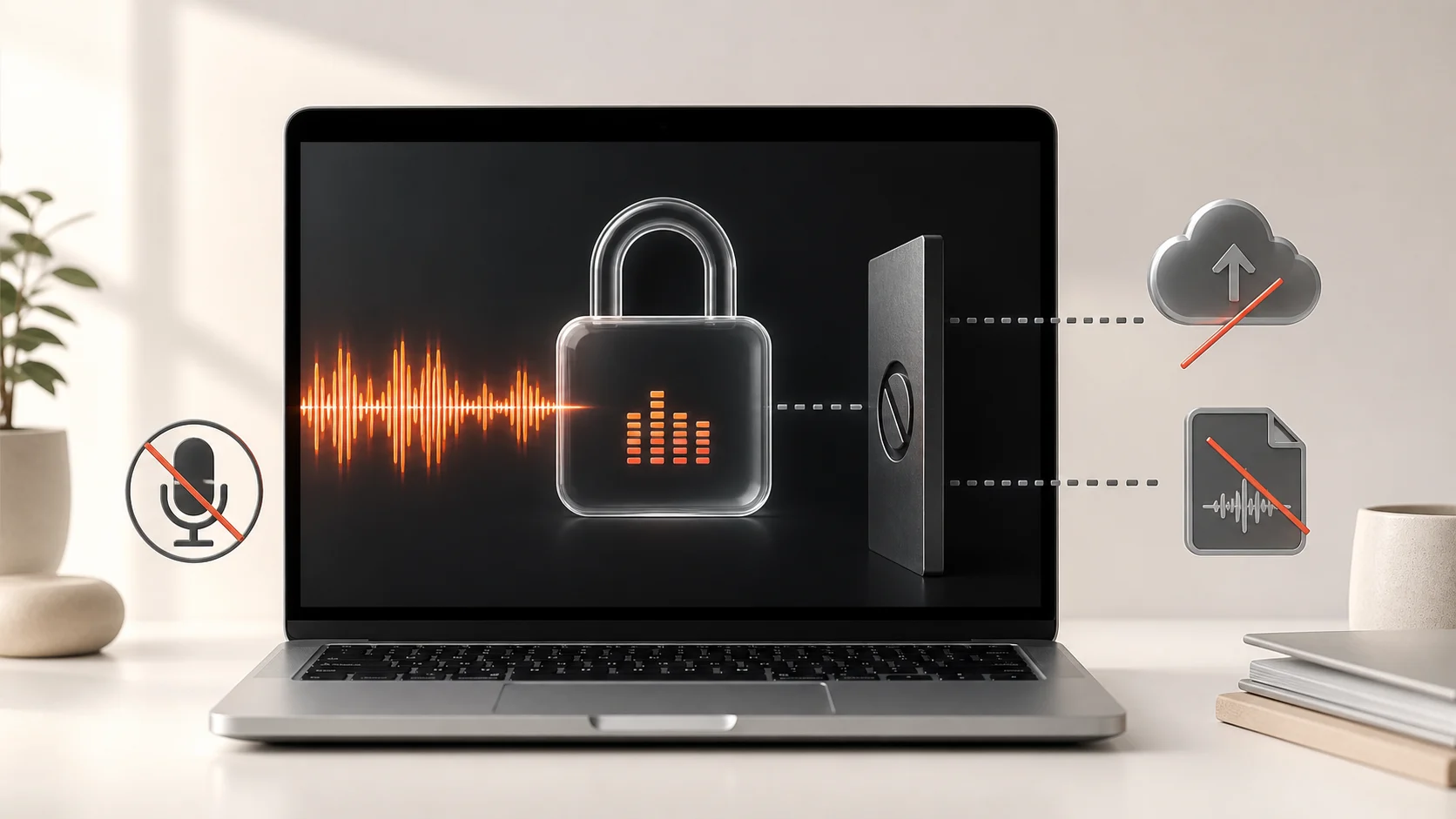
Audio access and audio storage are not the same thing. A visualizer must process a short-lived signal to react, but it does not need to upload songs, identify tracks or retain a recording.
Short answer
VoxelWall processes system audio locally to drive visuals and does not upload or store raw audio. Audio permission should be judged separately from analytics, purchase and optional device-support data.
Separate four different questions
| Question | Why it matters |
|---|---|
| Can the app access audio? | Required for a live response to system sound. |
| Does it retain raw audio? | Determines whether a temporary signal becomes a recording. |
| Does it send audio off-device? | Determines whether audio leaves the Mac. |
| Does it collect other product data? | Analytics and support data are separate from audio processing. |
The minimum data a visual needs
A renderer can be controlled by derived values such as intensity, frequency-band energy and transient peaks. These are instructions for motion, not a replacement copy of the song. Once a short analysis window has produced its values, the raw working samples are no longer needed for the next frame.
Track recognition is also optional. A visual can react without knowing the track title, account identity or playlist. That is why system-audio visualization can work across multiple players without logging into any of them.
VoxelWall’s boundary
VoxelWall analyzes audio on the Mac and does not upload or retain raw audio. Purchase or complimentary access and license delivery use the information needed to provide the entitlement. A small, one-time hardware snapshot may be sent after licensed activation for compatibility support; it is not a continuous monitor and it is not part of the audio pipeline.
That distinction is intentional. Product telemetry should not be disguised as a technical requirement. Audio response must continue to be about rendering the scene, while support data remains limited, documented and separate.
A privacy checklist for any visualizer
- Does the privacy policy explicitly say whether raw audio is stored or uploaded?
- Can it react without a Spotify or Apple Music login?
- Are analytics and crash reports described separately from audio processing?
- Can permissions be reviewed and revoked in macOS settings?
- Does the app explain any device or diagnostic snapshot and how often it occurs?
Processing, recording and uploading are separate actions
Processing means the app temporarily examines a signal to calculate something. Recording means it retains audio over time so it can be replayed or inspected later. Uploading means data leaves the Mac for another system. A live visual requires the first action; it does not inherently require the second or third.
This distinction should appear in product language, not only in a legal document. “Needs audio access” is incomplete because it tells the user what the operating system allows, not what the app does after access is granted. A useful explanation states the purpose, location, retention and destination of the data.
For VoxelWall, the purpose is visual response, the location is the Mac, raw audio is not retained and the raw signal is not sent to a server. Derived scene controls exist only to produce the current visual behavior.
Audio permission should not unlock unrelated collection
Permission to analyze system audio should not be treated as consent for marketing profiles, listening-history analysis or identity matching. Those would be separate purposes and should require their own explanation and lawful basis. A user can reasonably accept a reactive scene without accepting a record of what they listen to.
Purchase systems need an email, payment status and delivery information to complete an order. Product analytics may record page or feature events. Crash reporting may collect technical diagnostics. None of those systems needs raw song audio, so their data flows should remain independent.
Separation also reduces engineering risk. When the renderer can run without a cloud dependency, a network failure does not stop the wallpaper. When support data is optional and asynchronous, it cannot delay activation or the user’s first scene.
What a one-time hardware snapshot means
VoxelWall may send one small hardware snapshot after licensed activation, whether access was purchased or granted on a complimentary basis. Its purpose is to understand compatibility across Mac models, chips, graphics hardware, macOS versions and app versions. It is a single event, not continuous performance monitoring and not a live view of the user’s device.
The snapshot is not a prerequisite for rendering. Collection should happen off the critical path, fail silently if the network is unavailable and never block the wallpaper. It should exclude documents, browsing history, audio content and unrelated personal files.
This boundary matters because support value does not justify turning the app into a monitoring agent. A single compatibility record can help identify the lowest hardware in the installed base without occupying CPU, GPU or network resources after the event completes.
How to verify an app instead of trusting a slogan
- Read the permission explanation
It should name the feature that needs audio and what happens if access is refused.
- Read the privacy policy
Look for explicit statements about raw audio, uploads, retention, analytics and device information.
- Test offline behavior
A local visual engine should keep rendering after it has the resources and license state it needs.
- Review macOS settings
Confirm that permissions can be inspected and revoked by the user.
- Watch network activity if needed
Unexpected continuous transfers during audio playback deserve an explanation.
Frequently asked questions
Can an audio-reactive wallpaper hear private calls?
System-audio capabilities depend on the macOS route and permission. The important product question is what the app processes, retains and uploads. VoxelWall does not store or upload raw audio.
Does VoxelWall know which song I am playing?
Its visual engine does not need the track title, artist, playlist or account. It derives control values from the local signal.
Is the hardware snapshot always running?
No. It is designed as one small post-activation snapshot for compatibility support, not continuous hardware, CPU or GPU monitoring.
Can I revoke audio permission?
macOS provides privacy settings where users can review and change app permissions. The live audio response will not work without the signal it needs.